検証する3V0-21.25ソフトウエア &合格スムーズ3V0-21.25参考書勉強 |一生懸命に3V0-21.25 PDF問題サンプル
Wiki Article
BONUS!!! Tech4Exam 3V0-21.25ダンプの一部を無料でダウンロード:https://drive.google.com/open?id=1PGBXseabRxqaqlv1JsW-ioJuEggF4pWg
クcopyrightアントが支払いに成功すると、システムが送信する3V0-21.25ガイドの質問に関するメールを受け取ることができます。これにより、テストバンクをダウンロードして、3V0-21.25 STUDY教材を5〜10分で使用できます。メールはリンクを提供し、クcopyrightアントがリンクをクリックすると、クcopyrightアントはログインして学習する3V0-21.25学習資料を取得できます。手順は簡単で、クcopyrightアントの時間を節約できます。クcopyrightアントにとって時間は限られており、非常に重要です。当社の製品は、お客様の3V0-21.25練習エンジンをすぐにダウンロードして使用するというニーズを満たします。
VMware 3V0-21.25 認定試験の出題範囲:
| トピック | 出題範囲 |
|---|---|
| トピック 1 |
|
| トピック 2 |
|
| トピック 3 |
|
| トピック 4 |
|
| トピック 5 |
|
3V0-21.25参考書勉強 & 3V0-21.25 PDF問題サンプル
能力の尺度は何ですか?もちろん、ほとんどの企業は取得した資格の数に応じてレベルを判断します。包括的なものではないかもしれませんが、資格試験に合格することは雇用主を雇うための非常に簡単な方法です。 3V0-21.25試験の実践では、市場でこの募集現象について質問します。これは、3V0-21.25試験方法をユーザーがすばやく合格できるように調整されています。 3V0-21.25学習ガイドの品質は非常に優れており、これは3V0-21.25試験問題の年間合格率に反映されています。
VMware Advanced VMware Cloud Foundation 9.0 Automation 認定 3V0-21.25 試験問題 (Q13-Q18):
質問 # 13
An administrator clicks on Orchestrator to create a workflow in a VM Apps organization as shown.
Where would the administrator go next to enable Orchestrator?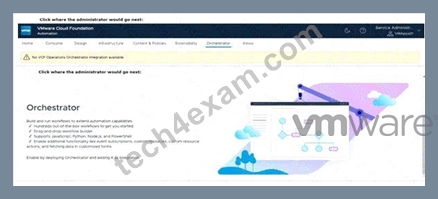
正解:
解説: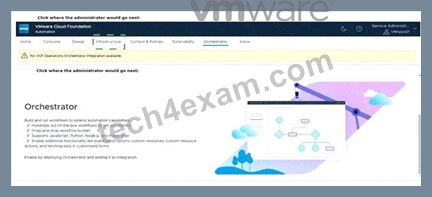
Explanation:
To enable the Orchestrator integration, the administrator must navigate to:
* Infrastructure (tab)
In VMware Cloud Foundation (VCF) 9.0, the VCF Operations Orchestrator (formerly vRealize Orchestrator) is a separate functional engine that must be explicitly integrated into the automation framework.
When an administrator selects the Orchestrator tab and encounters the warning message "No VCF Operations Orchestrator integration available," it indicates that the logical link between the Automation service and the Orchestrator appliance has not yet been established for that specific organization.
The standard administrative workflow to resolve this and enable extensibility is to move from the consumption/design view into the foundational infrastructure configuration. By clicking on the Infrastructure tab, the administrator gains access to global settings. From there, the administrator must navigate to Connections and then Integrations. Within the Integrations menu, the administrator can select "Add Integration" and specifically choose VCF Operations Orchestrator. This process requires providing the FQDN of the orchestrator server and appropriate service account credentials.
Once the integration is finalized and a successful data collection occurs, the portal's Orchestrator interface becomes functional, allowing users to build, run, and manage multi-cloud automation workflows across the VCF 9.0 fleet.
質問 # 14
What are two prerequisites to enable provisioning VMs via kubectl against tenant resources? (Choose two.)
- A. Create a new extensibility Action.
- B. Ask the Provider to generate a token via the system APIs.
- C. Generate an API token from the VCF Automation UI.
- D. Create a context via kubectl.
- E. Create a context via VCF CLI.
正解:C、E
質問 # 15
A VMware Cloud Foundation (VCF) Automation administrator manages two organizations:
* Finance is a VMApps Organization.
* Development is an AllApps Organization.
When creating a new project in the Development organization, the administrator notices that the available network options differ from those seen in the Finance organization.
Which two factors explain this difference? (Choose two.)
- A. Both Organization types use the same network options, but AllApps Organizations require enabling DHCP before routed networks are visible.
- B. VMApps Organizations provide access to Supervisor networks while AllApps Organizations restrict networking to isolated VPC networks.
- C. VMApps Organizations rely on traditional vSphere-backed or NSX-backed networks for virtual machine connectivity.
- D. AllApps Organizations support only ephemeral Kubernetes ingress networks, so persistent routed networks are not available.
- E. AllApps Organization networking includes VPC-based networks.
正解:C、E
解説:
In VMware Cloud Foundation 9.0, the distinction between VMApps and AllApps Organizations is fundamental to how resources are consumed. VMApps Organizations are designed for traditional virtual machine workloads, leveraging existing vSphere-backed distributed switches or standard NSX-backed segments. In this model, networking is typically managed at the infrastructure level, and the automation portal simply maps these segments to the project. Conversely, AllApps Organizations introduce a modern cloud- consumption model centered around Virtual Private Clouds (VPCs). This enables "AllApps" users to dynamically provision isolated network spaces, utilize VPC-based routing, and manage ingress/egress services natively within the organization. The Development organization (AllApps) sees VPC-based options because it is built to support both Kubernetes and VM workloads in a self-service, cloud-native fashion, whereas the Finance organization (VMApps) is restricted to the pre-defined, "traditional" network paths assigned by the provider. This architectural separation ensures that legacy VM environments and modern application development environments can coexist with the appropriate levels of networking complexity and isolation.
質問 # 16
Which statement correctly describes the relationship between a Project and an Organization in VCF 9.0?
- A. Projects are managed in SDDC Manager, while Organizations are managed in the vSphere Client.
- B. There is no relationship; they are independent management silos.
- C. An Organization can belong to multiple Projects to share resources.
- D. A Project is a sub-construct of an Organization used to group users and entitle them to specific resources.
正解:D
解説:
In the VCF 9.0 governance hierarchy, the Organization acts as the top-level administrative and billing boundary, while the Project serves as the granular operational unit. Every Project must reside within a single Organization. The Project is the primary mechanism for Role-Based Access Control (RBAC) and resource entitlement. Within a Project, the administrator maps Cloud Zones or Namespace Classes to specific sets of users and groups. This allows a large organization (e.g., "Engineering") to have multiple projects (e.g.,
"Project Alpha" and "Project Beta") with different resource limits and user permissions, all while sharing the same underlying organizational settings, identity providers, and regional infrastructure. Projects also allow for the isolation of Cloud Templates (blueprints); a template created in Project Alpha is not visible or deployable by users in Project Beta unless it is explicitly shared through the Service Broker catalog.
質問 # 17
An Organization Administrator for an AIIApps Organization in VMware Cloud Foundation (VCF) Automation must determine which networks are used by deployed workloads.
How does the administrator view the networks?
- A. The NSX segments mapped to each workload are visible by expanding deployment details for each deployed workload in the Organization Portal.
- B. VPCs, connectivity profiles and the associated NSX segment and Tier-1 gateway details can be retrieved with vcf-cli deployment get.
- C. The NSX Tier-1 gateway mappings for each workload in the Organization can be retrieved with kubectl get vm.
- D. VPCs and connectivity profile assignments are visible in the Organization Portal, but the underlying NSX Tier-1 gateways and segments are not.
正解:D
解説:
The AllApps (AIIApps) organization model in VCF 9.0 is built on the principle of high-level abstraction to simplify the developer experience. In this model, the Organization Portal presents networking through the lens of Virtual Private Clouds (VPCs) and Connectivity Profiles. The Organization Administrator can easily view which VPC a workload belongs to and what connectivity policies (such as public access or isolation) are applied. However, the underlying NSX implementation details-such as the specific Tier-1 gateways and segments automatically created by the Supervisor-are intentionally abstracted away from the organization-level view. This "cloud-style" visibility ensures that tenants can manage their application networking without being burdened by the complexity of the provider's physical or logical NSX fabric, which remains the exclusive domain of the Provider Administrator.
質問 # 18
......
Tech4ExamはVMware試験問題集を提供するウエブダイトで、ここによく分かります。最もよくて最新で資料を提供いたします。こうして、君は安心で3V0-21.25試験の準備を行ってください。弊社の資料を使って、100%に合格を保証いたします。もし合格しないと、われは全額で返copyrightいたします。
3V0-21.25参考書勉強: https://www.tech4exam.com/3V0-21.25-pass-shiken.html
- 試験の準備方法-認定する3V0-21.25ソフトウエア試験-実用的な3V0-21.25参考書勉強 ⤵ ➡ jp.fast2test.com ️⬅️サイトにて最新[ 3V0-21.25 ]問題集をダウンロード3V0-21.25ソフトウエア
- 気楽にVMware 3V0-21.25認定試験に受かるコツを知りたいのか ♻ ✔ www.goshiken.com ️✔️で⇛ 3V0-21.25 ⇚を検索して、無料で簡単にダウンロードできます3V0-21.25基礎訓練
- 正確的な3V0-21.25ソフトウエア試験-試験の準備方法-最高の3V0-21.25参考書勉強 ???? ウェブサイト✔ www.copyright.jp ️✔️を開き、☀ 3V0-21.25 ️☀️を検索して無料でダウンロードしてください3V0-21.25日本語版テキスト内容
- 3V0-21.25模擬試験最新版 ???? 3V0-21.25試験参考書 ???? 3V0-21.25模擬試験最新版 ???? ▶ 3V0-21.25 ◀を無料でダウンロード☀ www.goshiken.com ️☀️で検索するだけ3V0-21.25専門知識訓練
- 試験の準備方法-認定する3V0-21.25ソフトウエア試験-実用的な3V0-21.25参考書勉強 ???? 時間限定無料で使える⇛ 3V0-21.25 ⇚の試験問題は【 www.copyright.jp 】サイトで検索3V0-21.25試験解答
- VMware 3V0-21.25 Exam | 3V0-21.25ソフトウエア - 候補者の持ち込み 3V0-21.25参考書勉強 ???? 今すぐ“ www.goshiken.com ”を開き、➽ 3V0-21.25 ????を検索して無料でダウンロードしてください3V0-21.25日本語版問題解説
- 信頼できる3V0-21.25ソフトウエアを使用してVMware 3V0-21.25 試験を効率的に準備する ???? サイト➠ www.xhs1991.com ????で☀ 3V0-21.25 ️☀️問題集をダウンロード3V0-21.25専門知識訓練
- 3V0-21.25日本語問題集 ???? 3V0-21.25専門知識訓練 ???? 3V0-21.25ソフトウエア ???? 今すぐ☀ www.goshiken.com ️☀️で➠ 3V0-21.25 ????を検索して、無料でダウンロードしてください3V0-21.25日本語版受験参考書
- 正確的な3V0-21.25ソフトウエア試験-試験の準備方法-最高の3V0-21.25参考書勉強 ☸ ➠ www.copyright.jp ????を開いて▛ 3V0-21.25 ▟を検索し、試験資料を無料でダウンロードしてください3V0-21.25専門知識訓練
- 3V0-21.25日本語版問題解説 ???? 3V0-21.25日本語版受験参考書 ???? 3V0-21.25基礎訓練 ⛹ ( 3V0-21.25 )を無料でダウンロード➽ www.goshiken.com ????で検索するだけ3V0-21.25日本語問題集
- 3V0-21.25ソフトウエア ???? 3V0-21.25学習関連題 ???? 3V0-21.25専門知識訓練 ???? ▷ www.copyright.jp ◁サイトで“ 3V0-21.25 ”の最新問題が使える3V0-21.25日本語版問題集
- hylistings.com, poppiemmkw790997.actoblog.com, denisfawj465296.wikilinksnews.com, phoebewqaq721979.bloggerswise.com, amberichy242329.wikiconversation.com, bbsocialclub.com, nanaiezx068728.mdkblog.com, declanqjhx272719.blogsuperapp.com, deborahcbxc740427.cosmicwiki.com, www.stes.tyc.edu.tw, Disposable vapes
さらに、Tech4Exam 3V0-21.25ダンプの一部が現在無料で提供されています:https://drive.google.com/open?id=1PGBXseabRxqaqlv1JsW-ioJuEggF4pWg
Report this wiki page